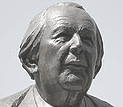
Jean Piaget's Educational Theory
Analyst: Sean Hughes |
![]() |
RETURN
reedited 11/13/08
1. Theory of Value: What knowledge and skills are worthwhile learning? What are the goals of education?
Piaget portrayed the child as a lone scientist, creating his or her own sense of the world. The individual will interpret and act accordingly to conceptual categories or schemas that are developed in interaction with the environment. The knowledge of relationships among ideas, objects, and events is constructed by the active processes of internal assimilation, accommodation, and equilibration (B: p. 39).2. Theory of Knowledge: What is knowledge? How is it different from belief? What is a mistake? What is a lie?
The study of children was thus a means of explaining the nature of human knowledge (C: p. 260).3. Theory of Human Nature: What is a human being? How does it differ from other species? What are the limits of human potential?
The biological structures that enable an organism to deal effectively with its environment (A: P. 8 5).4. Theory of Learning: What is learning? How are skills and knowledge acquired?
Each child builds on the previous stage of cognitive development, increasing the child's ability to solve more complex problems (E: p. 189).5. Theory of Transmission: Who is to teach? By what methods? What will the curriculum be?
In autonomous activity, children must discover relationships and ideas in classroom situations that involve activities of interest to them. Understanding is built up step by step through active involvement (G: p. 1).6. Theory of Society: What is society? What institutions are involved in the educational process?
Children are social beings who do not develop in cognitive isolation from others (F: p. 259).7. Theory of Opportunity: Who is to be educated? Who is to be schooled?
Piaget's concern was for the individual child, not the child in a social context. He was not interested in individual differences and cultural influences (B: p. 39).8. Theory of Consensus: Why do people disagree? How is consensus achieved? Whose opinion takes precedence?
The consistency of reasoning that Piaget predicted children would show across many tasks has not been found (K: p. 57). Piaget did not make enough of an effort to validate his theories by looking for alternative or rival explanations and then devise careful experiments to test his views (A: p. 89).
Piaget's theory has maintained continuity in most of its core assumptions (M: p. 191).
Emphasis on the importance of a single theory to provide consistency in teaching practice and evaluation (F: p. 1). Americans tended to see his theory differently, as cumbersome expressions of a dated biology that needed to be replaced by modern theories of learning (L: p.372).
|
See also,
Piaget re : Cognitive Development
|
A: Cleverly, J. Phillips, D.C. Visions of Childhood Influential Models From Locke to Spock. Teachers College Press, New York. 1986.
B: Oxford, R. (1997). Constructivism: shape-shifting, substance, and teacher education applications. Peabody Journal of Education, 72, 35-66.
C: Ewing, J. Kamii, C. (1996). Basing teaching on paiget's constructivism. Childhood Education, 72, 260-264.
D: Elkind, D. The Hurried Child, Growing Up Too Fast Too Soon. Addison-Wesley Publishing Company, New York. 1988.
E: Understanding Psychology. Random House, New York, 1986
F: Taylor, J. (1996). Piagetian perspectives on understanding children's understanding. Childhood Education, 72, 258-259
G: Building an Understanding of Constructivism, (http:Hwww.sedl.org/scimath/coml2ass/vOlnO3/2.bLmij. 6/18/01.
H: Boeree, G. Jean Piage . (http:Hwww. crystal inks. com/pi aget. htm). 6/18/01.
I: Smith, L. (Sept-Oct 1996). With knowledge in mind: novel transformation of the learner or transformation of novel knowledge. Human Development, 39, 257-263.
J: Papert, S. (1992). The Children's Machine: Rethinking School in the Age of the Computer. New York: Basic. 137-156.
K: Siegler (1991). Piaget's Theory of Development. 17-57.
L: Youniss, J. (Nov-Dec 1995). The skill useful classic concept of development. Human Development, 38, 373-379.
M: Beilen, H. (Mar 1992). Piaget's enduring contribution to developmental psychology. Developmental Psychology, 28, 191-204.