Analysts:
Scott Bovitch
Zach Cullimore
Tanesha Bramwell-Jones
Elizabeth Massas
Dominique Perun
|
|
RETURN
edited 11/18/18
Introduction
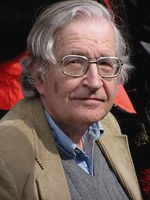
Noam Chomsky, born Avram Noam Chomsky, is widely considered to be the father of modern linguistics. His theory of generative grammar has informed generations of linguistic and cognitive researchers. Politically, Chomsky has been active in the discussion of America's foreign and domestic policies since the 1960's. He is also an outspoken critic of the American media, and a prolific author. In fact, according to the Arts and Humanities Citation Index, Chomsky is the most cited author living today.
Chomsky was born in Philadelphia, Pennsylvania in 1928 to William and Elsie Chomsky. The family lived in the East Oak Lane neighborhood of Philadelphia, a comparatively affluent area of the city. His was one of the only Jewish families in the neighborhood, with the rest of the population being mostly composed of Irish or German Catholics. As a result of growing up as a local ethnic minority, Chomsky has stated on several occasions that as a child he had a "visceral fear" of Catholics, one that took him a long time to overcome.
He attended high school in Philadelphia before moving on to the University of Pennsylvania where he studied linguistics, mathematics, and philosophy. He continued his education and developed his thesis at Harvard University and ultimately received his PhD in linguistics in 1955 from the University of Pennsylvania. He has since been teaching at the Massachusetts Institute of Technology.
As a young man, Chomsky's politics were directly influenced by his family and environment. His father, a professor of Hebrew, was a member of the Industrial Workers of the World party, a political organization formed to secure workers' rights and push back against the wage system of employment. For his own part, Noam became involved in several Hebrew organizations, owing at least partially to his childhood run-ins with Catholic youths, and developed a burgeoning interest in anarchist literature and platforms.
Chomsky is considered one of the most important linguists in the twentieth century. His main contribution in the field of linguistics is the influential "transformative-generative grammar" which is an attempt to describe the syntactical processes common to all human language mathematically (Smith, 1999). Chomsky draws a key distinction between the deep structure and surface structure of languages. He argues that the deep structure, which contains the meaning of a sentence, is not culturally determined but rather "hardwired" in the human brain. The meaning is then converted by a transformation into surface structure, which includes the sounds and words in a sentence. The Language Acquisition Device (LAD) is the hypothetical brain mechanism that according to Chomsky explained the acquisition of syntactic structure of language (McGilvray, 2005). Chomsky hypothesized that the language acquisition device was the system that determined the features of the child's native language. This falls under the realm of the nativist theory of language which states that humans are born with the innate ability for acquiring language (McGilvray, 2005).
Chomsky was drawn to politics at an early age while attending Central High School in Philadelphia. It was here that he wrote his first publication about the fall of Barcelona, Czechoslovakia and Austria. This was followed by a stream of political writings which throughout his lifetime illustrate an ability to provide political analysis, criticism, or decision. His writings angered a great deal of people for his thoughts were considered anti-American. He openly criticized the policies of the U.S., especially when dealing with foreign policy, and compared the government to radical terrorists. It was because of his political view on freedom and how it should be preserved for all, that he viewed the U.S. as a threat to foreign freedom. He simply saw this approach to foreign policy as a self interest to the U.S. and not that of individuals involved on foreign soil.
Chomsky's academic contribution and political involvement have sparked controversy and stimulated others to question authority and our current societal systems. We plan to discuss and investigate his stance on the meaning of value, knowledge, human nature, learning, education, society, individual opportunity and group consensus.
Theory of Value: What knowledge and skills are worthwhile learning? What are the goals of education?
Knowledge is described as the skills acquired by a person through experience, education and the practical application or understanding of a subject. The Oxford dictionary describes knowledge as facts, information acquired as well as the theoretical and practical understanding of a subject.
Traditionally, schools have been used as an instrument to transmit knowledge; however Chomsky opines that the skills and knowledge taught are often not worthwhile. "The goal of education", according to Noam Chomsky, "is to produce human beings whose values are not accumulation and domination, but instead are free association on equal terms."
According to Chomsky there is an instrumental approach to education. It is characterized as mindless, meaningless drills and exercise given "in preparation for multiple choice exams". This is evident through the state mandated curriculum where standardized tests are necessary to measure student growth and educational success. Chomsky argues that "the value of education should be placed on students' critical thinking skills and the process of gaining useful and applicable knowledge". However Chomsky's view of the factory model of education is that students are mandated to adhere to state written curricula where standardized tests are necessary. Students are inadvertently pushed to learn through memorization of facts, rather than through critical thinking.
Chomsky suggests that society simply reduces education to the requirement of the market. Students are trained to be compliant workers. The education process is reduced to knowledgeable educators who transfer information to those who don't know rather than to help students formulate higher level thinking skills on their own. In an interview with Donaldo Macedo, Chomsky describes education as "a deep level of indoctrination that takes place in our schools". Teachers are referred to as workers who merely carry out a task they were hired to do. Schools indoctrinate and impose obedience and are used as a system of control and coercion. Chomsky explains that an educated child by society's definition "is one who is conditioned to obey power and structure".
Chomsky complains that children are not taught to challenge and think independently, yet they are taught to repeat, follow orders and obey. Education is described as a period of regimentation and control, with a system of false beliefs. Based on these analyses, the goals of education should be to encourage the development of the child's natural capacity.
Theory of Knowledge: Generative Grammar and Cognitive Theory
The majority of Chomsky's writings with regard to the nature of knowledge pertain specifically to the construction and use of language. His theory of Generative Grammar, though constantly evolving, stands as a microcosm of his views on the human mind's methods of taking in and storing information. While much of it is primarily applicable to the field of language, there is more than enough here to illustrate his core ideas about education and the formation of human thought and knowledge.
"Human thought has been formed through centuries of man's consciousness, by perceptions and meanings that relate us to nature. The smallest living entity, be it a molecule or a particle, is at the same time present in the structure of the earth and all its inhabitants, whether human or manifesting themselves in the multiplicity of other forms of life." Knowledge of Language: its origin, nature and use, pg xi (Chomsky, 1986)
At its heart, Chomsky's theory of Generative Grammar is a way of describing the way people learn to communicate. The core of this theory is the idea that all human language originates from a common source, an innate set of grammatical rules and approaches that is hardwired into the human mind. This is a very naturalistic approach, but one that has found ever increasing acceptance amongst experts in the field (Chomsky, 1986).
His fundamental approach to knowledge is very similar to that used in Information Processing Theory. According to Chomsky, in order for knowledge to be retained, there must be previous knowledge already present for the new information to be associated with. He typically refers to this process as "building" on prior knowledge, but it has obvious parallels with the "networking" described by IPT. Particularly in the process of taking in information initially, generative grammar has direct parallels with the ideas put forward for information processing theory (Miller, 1956).
In a bit of a twist on the initial networking concepts of Information Processing Theory, Chomsky postulates that, once integrated into a network, some knowledge, specifically procedural knowledge, becomes irreducible in complexity (Chomsky, 2000). Once something is known and successfully networked, it is possible for it to become intrinsically tied to its immediate network in the mind of the learner. In Chomsky's words;
"Notice that similar considerations show that knowing-how - for example, knowing how to ride a bicycle - cannot be analyzed in terms of abilities, dispositions, etc.; rather, there appears to be an irreducible cognitive element." - New Horizons in the Study of Language and the Mind, pg 52 (Chomsky, 2000)
Chomsky's view of knowledge is heavily cognition-centric, as one would expect from a linguist. His theoretical framework approaches the concept of "knowing" as a purely cognitive phenomenon, separate from one's ability to apply that knowledge directly to the world. This approach is nearly as purely cognitive as possible, almost anti-behavioral in its bent. Chomsky himself almost says as much;
"Notice finally that an account of knowledge in terms of ability, taken in anything like its normal sense, has proven utterly unproductive." - New Horizons in the Study of Language and the Mind, pg 52 (Chomsky, 2000)
It is the idea of innate and natural grammar that really sticks. While there is little dispute at this point that some of the more fundamental functions of the human brain are transmitted as instincts. We don't have to be taught to breathe, after all. The concept of an underlying mental matrix that informs all of human language is a bit of a departure from more traditional views on the origin of verbal communication (Chomsky, 2000).
This view is decidedly naturalistic. Rather than the cultural development of spoken language through generations of trial and error, this would imply that it has all been merely a reconstruction of instincts that were already present. Each and every language spoken today, then, would have a common root in the language center of the human brain. The different forms that those languages then took could be attributed to different opportunities and approaches to networking the new verbiage and syntax.
Theory of Human Nature: What is a human being? How does it differ from other species? What are the limits of human potential?
Noam Chomsky has a very naturalistic or innate view of human nature. According to Chomsky, (Soper, 1998) he sees a human being as a biological organism like any other, except that it is endowed with a unique intellectual capacity to think and reason and to express these thoughts and reasons (communication),and that these are contingent upon freedom. He believes these abilities are internally linked to our genetics just as our visual systems, muscular systems and all other biological systems. During an interview with Michel Foucault, Chomsky (1971) states:
"If this hypothetical Martian were then to observe that every normal human child immediately carries out this creative act and they all do it in the same way and without any difficulty, where as it takes centuries of genius to slowly carry out the creative act of going from evidence to a scientific theory, then this Martian would, if he were rational, conclude that the structure of the knowledge that is acquired in the case of language is basically internal to the human mind." (11)
The root of this concept purposes that, if a human is genetically sound, he or she will be able to develop these abilities regardless of other circumstances, such as, where they were born, or who they were born to. This is the naturalistic and innateness of our nature that will allow a human to obtain and use capacities such as thinking, reasoning and communication.
In addition to his naturalistic view of humans and their abilities to think and communicate, He also believes there is universality to these traits, especially with regards to morality, that can be found across different cultures. Chomsky (1998) supports this idea with the fact, that people of different cultures can, and do, find common ground on which to have discussions as he states in an interview with Kate Soper:.
"We can begin to see human nature in terms of certain capacities to develop certain mental traits. I think we can go further than this and begin to discover universal aspects of these traits which are determined by human nature. I think we can find this in the area of morality. For example, not long ago I talked to people in the Amazon tribes and I took for granted that they have the same conception of vice and virtue as I do. It is only through sharing these values that we were able to interact—talk about real problems such as being forced out of the jungle by the state authorities. I believe I was correct to assume this: we had no problem communicating although we were as remote as is possible culturally." (1)
Chomsky builds and extends this universal morality to every culture and every individual and states that they do the things they do to enhance human life. Chomsky (1998) elaborates upon this by stating:
"They create stories of themselves where they interpret their actions as working for the benefit of human beings. Even at the extreme levels of depravity, the Nazis did not boast that they wanted to kill Jews, but gave crazed justifications -- even that they were acting in "self-defense." (1)
The key is that people "justify" why they do the things they do, and he claims this is universal across all cultures.
Perhaps the most important aspect to Chomsky's belief of human nature lies within in his fundamental view of our ability to be creative and to have the freedom to express it. This freedom is necessary to manifest and cultivate these creative capacities. We can reflect on this by thinking of the first few humans who started to conjure up a common language. After many trials of putting grunts and sighs together and cooperating with one another our ancestors have created the many languages that we know of today. It is with this concept freedom to express our creativity that Chomsky gets entangled with Politics. Chomsky (1988) has said:
"Having this view of human nature and human needs, one tries to think about the modes of social organization that would permit the freest and fullest development of the individual, of each individuals potentialities in whatever direction they might take, that would permit him to be fully human in the sense of the greatest possible scope for his freedom and initiative." (144)
And, this exact situation seems to be hindered with some current positions of states and governments. Some people counter this argument that people should be free to express their creativeness, especially in reference to bad or destructive creativeness, such as was the case with the Nazis and Jews during the Holocaust. While this may hold true in terms of political debate it remains mute to deny this in the view that its part of human nature.
IV. Theory of Learning: What is learning? How are skills and knowledge acquired?
According to Chomsky, language defines what it means to be human and the study of language is a way in to the study of the human mind. "Although having a language is not a prerequisite for having a mind, language is overwhelmingly our best evidence for the nature of mind" (Smith, 1999). With regard to learning language, Chomsky purports that some aspects of language are explicitly taught in school such the spelling conventions of the written representation of language and forms of technical vocabulary; however, the most fundamental aspects of language are universal. We all know the same unique human language. This notion of universal grammar is the set of linguistic principles that we are endowed with at birth in virtue of being human (Smith, 1999). Chomsky also asserts that there is a genetically determined "window of opportunity" for language acquisition. If the child does not learn its first language during this period, then it will never attain full "native-like mastery" of any language (Smith, 1999). Chomsky has at many times presented many different kinds of evidence in favor of the claim that language is in large part genetically determined including the speed and age-dependence of acquisition. For example, it can be said that we do not need to "learn" that our language contains nouns and verbs; all language contains nouns and verbs (Smith, 1999). We do however; need to learn the noises within the language that are associated with nouns and verbs.
Chomsky also maintains that there is a biological entity, a finite mental organ that develops in children along one of a number of paths, which are determined in advance of any childhood experience. The language organ that emerges, the grammar, is represented in the brain and plays a central role in the person's use of language. Human language describes the distinctive qualities of the mind that are unique to man. The normal use of language can also be thought of as a creative activity. Chomsky notes that we do not understand and may never come to understand what makes it possible for normal human intelligence to use language as an instrument to convey thought and feeling (McGilvray, 2005).
With regard to learning, it can be summarized that knowledge grows and matures within us. Acquisition of knowledge is not something that we actively do, but yet something that happens to us. The course of development is largely due to the nature of our internal foundations (McGilvray, 2005).
Theory of Transmission: Who is to teach? By what methods? What will the curriculum be?
According to Chomsky, the goal in teaching is to help cultivate growth and to help the students become interested in learning. He states that students, "typically they come in interested, and the process of education is a way of driving that defect out of their minds. But if children's normal interest is maintained or even aroused, they can do all kinds of things in ways we don't understand…hellip;" (Chomsky, 1992). In other words, the teacher's role in the transmission of learning is to keep the children engaged in the learning process and interested in exploration and independence. The focus is on the students learning rather than the teachers teaching.
In an interview with Lillian R. Putnam in the Fall of 1987, Chomsky was asked, "If teachers from primary grades were familiar with your work, what kinds of changes or emphases might they make in reading instruction? What general suggestions would help them?" To this Chomsky replied, "I'm hesitant even to suggest an answer to this question. Practitioners have to decide for themselves what is useful in the sciences, and what is not. As a linguist, I have no particular qualifications or knowledge that enables or entitles me to prescribe methods of language instruction. As a person, I have my own ideas on the topic, based on my own experience (in part, as a teacher of language to children), introspection, and personal judgment, but these should not be confused with some kind of professional expertise, presented from on high. My own feeling, for what it is worth, is that at any level, from nursery to graduate school, teaching is largely a matter of encouraging natural development. The best "method" of teaching is to make it clear that the subject is worth learning, and to allow the child's -- or adult's -- natural curiosity and interest in truth and understanding to mature and develop. That is about 90% of the problem, if not more. Methods of instruction may influence the residue." Accordingly in an interview with Gary Olson and Lester Faigley, Chomsky states that teaching is mostly "common sense". It does not matter what is covered; but how much you develop the capacity to discover (2007).
Theory of Society: What is society today? What institutions are involved in the educational process?
Chomsky describes society today as a "modern industrial civilization" and "the driving force in this modern industrial civilization" as "material gain" (Chomsky, 2007). A civilization based on this principle economic and "material gain" is in danger.
If modern industrial society were to aspire to change , "the condition of survival, let alone justice, would require rational social planning in the interest of the community as a whole and by now that means the global community" (Chomsky, 2007). This means a society would need to first consider the "mutual interest" of the community rather than their own "self-interest" in social planning (Chomsky, 2008).
According to Cohen and Roger (1991), Chomsky believes there is hope for society and it is "set against the background of his conception of human nature" and "the conception of an instinct for freedom that lies at its heart" (p. 14). He hypothesizes that the "constraints on human freedom that are not 'required for survival in the particular state of history' will tend to be sloughed off, as a result of the moral nature of human beings, the 'instinct for freedom', and the 'continual efforts to overcome authoritarian structures and to expand the domain of freedom' that results from that instinct" (Cohen, 1991). In other words, an encroachment on human rights in society goes against our instinctual human nature and subsequently the denial of these freedoms will be investigated. Slavery and women's rights (Arnove, 2005) are examples of these infringements.
According to Chomsky, a true society is not governed by a dominating hierarchy seeking to retain power He states that "a truly democratic community is one in which the general public has the opportunity for meaningful and constructive participation in the formation of social policy: in their own immediate community, in the workplace, the society at large" (Arnove, 2005). Chomsky favors the erosion of coercecive power over society. As an anarchist, he (McGilvray, 2005) would want to switch "authoritarian structures", with "democratic institutions based on fully participatory worker organizations (his syndicalism)." He also requires (McGilvray, 2005) from "powerful institutions" a structure which gives workers more autonomy at all levels of the institution. "He knows that the sole form of control of authority that most people can exercise consist of voting for representatives in local, municipal, regional, and national forms of government. Thus, in current circumstances, Chomsky the anarchist paradoxically supports efforts to increase the power of the state, at least where it can serve to regulate and check otherwise largely unconstrained and otherwise unaccountable corporate authority' (McGilvray, 2005). In Chomsky's view of society, "it would be 'very liberating' for the wealthy, as well as for the poor, for the privileged as well as the underprivileged, to be able to live in a society where the human essence is not defined in terms of maximizing production, and producing "on demand" (McGilvray, 2005). Chomsky has hopes for a society which has freed itself from material gain and coerces powers and exerts instinctually what is in their human nature to seek change for the sake of human rights and mutual interest of the whole society.
Chomsky makes a similar connection with respect to educational institutions in today's society. According to Chomsky, schools, college and universities in today's educational institutions are similar to factories. Students are indoctrinated by "liberal elites" or "intellectuals" to increase their obedience and conformity. The "liberal elites" or "intellectuals are the ones who write history" used in schools and "we should be cautious about the alleged "lessons of history" in this regard; it would be surprising to discover that the version of history presented is self-serving and indeed it is" (Arnove, 2005).
Currently, Chomsky's considers educational institutions today to be where "human beings have no intrinsic, moral and intellectual nature, that they are simply objects to be shaped and private managers and ideologues-who, of course perceive what is good and right" (Arnove, 2005). Instead, educational institutions should be interested in "what the student discovers for themselves when their natural curiosity and creative impulse are aroused not only will be remembered but will be the basis for further exploration and inquiry and perhaps significant intellectual contribution" (Arnove, 2005).
Theory of Opportunity: Who is to be educated? Who is to be schooled?
If one is to examine Chomsky and his writings, they would be able to find an underlying concept that illustrates one of his biggest claims to human rights. It is this. People are to be free and should have the freedom to express themselves in cooperation with others, and this freedom should not be oppressed by a governing body. According to Edgley (2005) Chomsky argued: "If humans are essentially creative with an "instinct for freedom" to pursue cooperative ventures, then states and capitalism must work against human nature, because both concentrate power into the hands of a few, thereby denying the many necessary conditions for cooperative, creative humanistic productive activity." This is enough to support that Chomsky would support education for all who want education, that no one should be exempt from the opportunity, while at the same time, no one should be forced into it either. The key to his idea is that it should be up to those who want, and not those who are forced.
Chomsky's idea of who is to be schooled follows the same pattern as who is to be educated; those who want to be. What Chomsky would suggest, is that the school follow a very democratic way of instruction without the use of indoctrination. As Chomsky (2000) comments on his own style of teaching: "I don't try to persuade people, at least not consciously. Maybe I do. If so, it's a mistake. The right way to do things is not to try to persuade people you're right but to challenge them to think it through for themselves."
Theory of Consensus: What is consensus? Why do people disagree? How is consensus achieved? Whose opinion takes precedence?
Chomsky's believes, in very broad terms, that consensus is the mutual agreement of mankind when they assume the responsibility of managing and governing themselves in communities, workplaces and society. A given society reaches agreement or consensus through a cohesive collaboration that aspires to find mutual agreement among members of the community. The goal is to represent the ideals and concerns of the society versus the self-interest of any one dominating person, group or organization. Obviously, this is an extremely broad and idealized treatment of the phenomenon. Chomsky seems to think in very broad terms, though, even as he approaches specific societies.
A true society considers the ideals, concerns and freedom of society as an entitlement. These entitlements if challenged by an authoritative governing body in a society will lead unnecessary constraints and disagreement. Society will disagree when their ability to cooperatively manage its own ideals, concerns, and financial viability is infringed by an outside authority. "He speculates that constraints on human freedom that are not required for survival in the particular state of history will tend to be sloughed off." as a result of the moral nature of human beings, the 'instinct for freedom', and the 'control effort to overcome authoritarian structures and to expand the domain of freedom 'that results from that instinct" (Cohen and Rogers, 1991).
In terms of consensus, Chomsky's view is that people of power within the United States have traditionally used the media as a form of propaganda to leverage consensus through the masking of facts to their own benefit. This was the case in many instances when the United States government and various European governments have exhorted their power to leverage economic control whether it was a hungry for land, oil, or any other commodity of value as a means for an end (Chomsky and Herman, 1988)
"Quite typically, intellectuals have been ideological and social managers, serving power or seeking to assume power themselves by taking control of popular movements of which they declare themselves to be the leaders. For people committed to control and manipulation it is quite useful to believe that human beings have no intrinsic moral and intellectual nature, that they are simply objects to be shaped by state and private managers and ideologues-who, of course perceive what is good and right" (Arnove, 2005).
Somewhat ironically, Chomsky's admonition of the intellectual comes in the face of the fact that he is himself viewed by many as a prime example of the term. For reasons related to his outspoken criticism of the policies of the United States' government and the media that he views as supporting those policies, Chomsky is seen by some as anti-American and he is often used as an example of "liberal intellectualism". His theories on consensus are indeed rather collectivist and represent an idealized democracy, where each member of a society has equal (or nearly equal) say in how that society moves forward. It would seem to be this view that has fueled much of his criticism of United States government policy, both foreign and domestic, over the years.
References
Arnove, A. (2008). The Essential Chomsky. New York, N.Y.: The New Press
Chomsky, N. (2000). Chomsky on miseducation. Oxford.
Chomsky, N. (2002). Chomsky on democracy and education.
Chomsky, N. (1986). Knowledge of language: Its origin, nature and use. Westport: Greenwood
Chomsky, N. (2000). New horizons in the study of the mind. Cambridge: Cambridge University Press
Chomsky, N. (1988) Noam Chomsky: language & politics, Montreal: Black Rose Books.
Chomsky, N. (1992) Conference titled "Creation and Culture" Barcelona Spain, November 25, 1992
Chomsky, N. (2006) Language and mind 3rd Ed. Cambridge, United Kingdom: Cambridge University Press.
"Chomsky on Civilization, Society, Power, and Human Nature." (2008.) Retrieved from http://www.youtube.com/watch?v=PT8tbEXYeT0
Elders, F. (1998) "Human Nature: Justice versus Power" Noam Chomsky debates with Michel Foucault.
"Language, Language Development and Reading" Noam Chomsky interviewed by Lillian R. Putnam,
Fall 1987 Reading Instruction Journal retrieved from http://www.chomsky.info/interviews/1987----.htm
"Language, Politics, and Composition: A Conversation with Noam Chomsky" interviewed by Gary A. Olson and Lester Faigley (2007) retrieved from http://lilt.ilstu.edu/theory/authors/chomsky.htm
McGilvray, J. (Ed.) (2005). The Cambridge companion to Chomsky. Cambridge, United Kingdom: Cambridge University Press.
Miller, G.A. (1956). The magical number seven, plus or minus two: Some limits on our capacity for processing information. Psychological Review, 63, 81-97
"Noam Chomsky on Society". (n.d) Retrieved from http://www.youtube.com/watch?v=QR2QFHsBWnU
Knowledge, Morality and Hope: The Social Thought of Noam Chomsky. (1991) Retrieved from http://www.chomsky.info/articles.htm
Salkie, R. (1990) The Chomsky update: Linguistics and politics. Cambridge, MA: Unwin Hyman Inc.
Smith, N. (1999) Chomsky ideas and ideals. Cambridge, United Kingdom: Cambridge University Press.
Soper, K. (1998) "On human nature" Noam Chomsky interviewed. Red Pepper
©2011 NewFoundations