RETURN
edited 4/13/14
Introduction
While teams are not a new phenomenon, they currently are a popular way for organizations to provide a structure that places power in the hands of employees as well as management. Many contemporary organizations have created team-based work structures that are significantly different than the hierarchical and control-based organizations of the industrial era. However, advances in communication technologies have dramatically changed the nature of teamwork. Traditional collocated groups are being replaced with virtual teams, distributed across boundaries of time, space and organizational structures.
The Industrial Age was characterized by hierarchical organizations that relied on management direction and organizational departmentalization to provide order and consistency. Rules and auditing processes were important means of control. Employees’ roles and responsibilities tended to be specialized and information typically went to management rather than to employees. Hard work was encouraged more than a balance between work and home life. Conservative improvements tended to be the norm because organizational controls typically inhibited risk taking (Fisher and Fisher, 1998).
Unlike rational organizational structures of the past, teams rely on employee empowerment rather than management control and direction. Team organizations have created work structures that are more democratic and flexible with a common mission of sharing responsibility for results and decisions between management and workers. The ideal team is characterized by a global rather than departmental focus. Problems are controlled at the source rather than by a separate policy function. Information tends to go to employees and there is more of an emphasis on work and home life balance as opposed to long hours. Continuous improvement is highly valued. Instead of promoting employees with highly specialized skills, team-based operations focus on creating flexible, cross-trained and multi-skilled team members. Self-managing teams are said to be the key to leaner and more flexible organizations capable of adjusting rapidly to changes in the environment and technology (Fisher and Fisher, 1998).
Virtual teams are the next logical step in the evolution of organizational structures (Lipnack and Stamps, 1999). Presently, people work across internal organizational boundaries such as specialized functions and departments as well as external organizational boundaries such as alliances with vendors, industry associations and even competitors. Virtual teams explore a new type of boundary-crossing organization utilizing technology and information.
Like other types of organizations that must acclimate to changes in their environment, higher education institutions are expected to adapt teaching and facilitation techniques that encompass new and emerging delivery systems. Education programs have already begun to embrace technology with the innovation of distance education. Virtual teams may introduce the next step in advancing the effective facilitation of collaborative team learning. This paper will focus on the emergence of virtual teams in organizational structures and explore the benefits and limitations of their incorporation into distance education.
Defining Virtual Teams
In order to understand the concept of a virtual team, it is critical to define what constitutes a team and what makes it virtual. The use of the word virtual, as in the virtual team, the virtual organization or the virtual classroom is meant to denote the meaning of the use of electronics in enabling the flow of information for specific reasons. The success in creating a virtual world depends on how clearly the objectives have been defined and to what extent the process necessary for the accomplishment of the objective has been designed (Norton and Smith, 1997).
In organizations today, the word team can be used in seemingly incompatible ways. While it is sometimes used to describe a participative workplace where everyone has involvement, it can also be used to reinforce the traditional autocratic paradigm of being a “team player”. Katzenbach and Smith (1993) define the word team as meaning a collection of individuals who a share a clear and common purpose. Being believed to have a common purpose is what differentiates a team from a group, which is simply a collection of people. Therefore, organizations that lack a common aspiration cannot by definition be considered a team.
Fisher and Fisher (1998) further assert that having a clear purpose and common agreement to achieve that purpose in and of itself does not distinguish classic bureaucracies from what are currently called team-based operations. They define teams as nonauthoritarian organizational structures commonly used for shared responsibility and employee empowerment. They propose that team operations be based on employee commitment rather than management control. Unlike groups, teams hold themselves accountable for the outcome.
With the advent of so many communication technologies, organizations are seizing the opportunities to “work together apart”. Like traditional types of teams, virtual teams engage a group of individuals to work independently towards a common goal. Unlike conventional teams, a virtual team works across time, space and organizational boundaries with links strengthened by webs of communication technologies (Lipnack and Stamps, 1997).
In addition to their cross-boundary approach, virtual teams also offer a new way of managing knowledge. Outsourcing, downsizing and programs of planned redundancy all mean a reduction in existing staffing level . As attrition in organizations occurs, a valuable stock of corporate knowledge leaves along with the employees, including how work is done in practice and how it is done in a particular domain. (Kimble, Li & Barlow, 2000). There is now an urgent need for new ways of thinking about how knowledge is shared within organizations (Kimble, Li & Barlow, 2000).
Principles of Virtual Teams and Systems Theory
In their application of systems theory to virtual teams, Lipnack and Stamps (1997) assert that the principles of people, purpose and links form a simple systems model of inputs, processes and produced outputs. People make up the virtual teams, purpose is the task that holds teams together and links are the interactions and channels that weave the fabric of the team. The nature and variety of these links are the most distinguishing factor between virtual and traditional teams. Figure 1 displays the principles that provide an integrated framework for understanding and working in virtual teams.
The inputs needed to develop virtual teams include independent members, cooperative goals, and multiple media (Lipnack and Stamps, 1997). Throughout the development process, the members share leadership and engage in interdependent tasks, which involve boundary-crossing interactions. The generated outputs include integrated levels of organizations, concrete results and trusting relationships.
Figure 1: Virtual Team System of Principles
| |
Inputs |
Processes |
Produced Outputs |
| People |
Independent
Members |
Shared
Leadership |
Integrated
Levels |
| Purpose |
Cooperative
Goals |
Interdependent
Tasks |
Concrete
Results |
| Links |
Multiple media |
Boundary-crossing interactions |
Trusting Relationships |
(From Virtual Teams, Lipnack and Stamps, 1997). .
Virtual teams are composed of individual members with certain areas of expertise. Because of this diversity, members typically share leadership by assuming leadership positions at some point in the process. And because teams are also embedded in organizations, they themselves are parts of larger systems. Therefore, they must integrate both the level of the members and the level of the group.
Three elements of virtual teams allow them to achieve their purpose: cooperative goals, interdependent tasks and concrete results. Virtual teams rely upon a clear purpose because of their cross-boundary work. Cooperative goals define the outputs desired, while interdependent tasks connect those desired outcomes to those achieved. When a team has completed its process, it expresses its purpose as concrete results.
Links are what give virtual teams their distinction from in-the-same-place organizations. Multiple media (wires, phones, computers, etc.) are the channels by which the members make the physical connection. These connections allow communication and boundary-crossing interaction that make virtual teams truly different. Through interactions, people develop trusting relationships in their patterns of behavior that persist and feed back into subsequent interactions. While it can be argued that trusting relationships are needed by all teams, they are even more important to virtual teams because of a lack of face-to-face time. This trust may even have to replace hierarchical structures and bureaucratic controls (Lipnack and Stamps, 1997).
The Virtuous Loop: Teams & The Cybernetic Model
Cybernetics focuses on the ability of an organization (or team) to engage in self-regulating behavior by a process of negative feedback (Morgan, 1996). By avoiding negative outcomes, or deviations from standard norms, the organization stays on track. The simple cybernetic model, functioning like a thermostat, demonstrates the ability to monitor the environment, as well as the capacity to detect and correct deviations from set guidelines. Modern cybernetics draws the distinction of the ability to question the appropriateness of those predetermined norms before initiating corrective action. Morgan (1997) distinguishes this as the difference between “single loop” and double loop learning (Figure 2).
The virtual feedback loop begins with the assumption of a rational model of organization consisting of building blocks of collocated groups stacked in command and control pyramids. Teams work “shoulder to shoulder” and pass their work to the next team in chains of larger processes, similar to a bucket brigade. However, competitive pressures from the environment to cut costs and improve quality are challenging this design. As a consequence, people working on interdependent tasks are no longer necessarily proximate in the space and time or even in the same organization. This leads to problems pertaining to distance, time and hierarchical structures.
Figure 2: Double Loop Learning
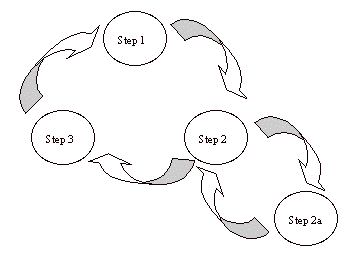
Step 1 = The process of sensing, scanning, and monitoring the environment
Step 2 = The comparison of this information against other operating norms
Step 2a = The process of questioning whether operating norms are appropriate
Step 3 = The process of initiating appropriate action.
(From Images of Organizations, Morgan, 1996).
Virtual teams address the issue of distance and time by replacing collocation with a combination of technology and face-to-face meetings. They deal with issues pertaining to hierarchical structures through cross-boundary work. This facilitates double loop learning by creating ways for people to communicate interactively.
Barriers to Virtual Teams
Trust and identity are two significant issues for efficient creation and operation of virtual teams. Identity plays a critical role in communication and yet, when spatial borders separate team members, identity is ambiguous. Basic indicators of personality traits and social roles are harder to identify. Unlike the physical world that consists of matter, the virtual world is composed of information that is diffused over time and space. There is no law of the conservation of information. Along with identity, trust is also a crucial component of cooperative endeavors. Without trust, the management of a virtual organization cannot be conceived (Kimble, Li & Barlow, 2000).
In addition to trust and identity, there are a number of technological problems that present barriers to success. Virtual teams require multimedia communications incorporating voice, data, text and video. This infrastructure is not always available in certain areas or is often cost-prohibitive to the organization. Even after the difficult selection of appropriate technologies and services has been made, the additional cost in maintaining the system need also be considered. Also, most equipment and software available today has been designed for use in a conventional office, and may not always be adaptable to a virtual environment.
Finally, organizational and cultural barriers are another serious impediment to the effectiveness of virtual teams. Many managers are uncomfortable with the concept of a virtual team because successful management of virtual teams may require new methods of supervision (Jarvenpaa and Leinder 1998). Managing the logistics of communication alone can prevent organizations from developing a common ground. Additionally, managers may not be able to rely on frequent visual contact with employees to ensure that work is being done.
Distance Learning and Virtual Teams
College institutions in the United States were built in a different era than we are currently facing. Cyrs (1997) asserts that our educational institution reflects industrial-era roots that are organized around centralized structures (similar to the factory model) by aggregating the workers (faculty and students) at a particular place (the campus) at a particular time (the academic calendar). Just as the American economy has changed, it has been argued that structures of education will need to shift away from an industrial model to one which is more decentralized, information-based, technology-driven and niche oriented (Cyrs, 1997). The traditional model, which aggregates human resources at a single location, at a specific time, to serve a large population of students, now has a major competitor.
There have been several pressures on higher education to enter into a more technological age. The impetus to transition higher education from an industrial to an information paradigm derives from a number of technological, economic, demographic political and pedagogical trends. Providing distance learning resources to match the needs of nontraditional students has created difficulties for increasing numbers of higher education institutions.
Like the industrial model, the process of developing materials for learning and teaching at a distance were molded by the principles of rationalization including a division of labor, specialization and automation. Peters (1994) defines distance learning as a rational method “ of providing knowledge which, as a result of applying the principles of industrial organization as well as the extensive use of technology, thus facilitating the reproduction of objective teaching activity in any numbers, allows a large number of students to participate in university study simultaneously regardless of their of residence and occupation” (Peters, 1994, p.125).
As more and more programs are migrating towards distance learning, educators are being forced to evaluate traditional teaching methods. Team-based learning, which has been proven effective in organizational structures, may become an increasingly viable option for the future of higher education. Delivering effective, pedagogically-sound educational programs on-line is of great interest for many learning communities, provided that technology can be maximized and limits be minimized by the organizational structure.
Virtual Teams Vs. Traditional Models
The greatest difference between traditional and virtual methods of teaching is the type and extent of interaction. In traditional classrooms, there is a potential for a high amount of interaction between the student and the instructor as well as the other students. However, if a lecture format is strictly utilized, this interaction will never occur. In virtual classrooms, the technology supports collaborative learning, heterogeneous groupings, problem solving and higher order thinking skills not always found in a lecture format.
Not only are there significant differences between face-to-face and on-line instruction, but the organizational structure is varied as well. Traditional education is dependent on the instructor’s defined task, time frame and resources, whereas in most on-line programs, delivery of instruction is dependent on the team’s collective effort in meeting the task with team-dependent time frames and resources.
Dynamics of Virtual Team Learning
The greatest value of team learning may also be its greatest challenge (Bailey & Luetkehans, 1998). Because virtual learning teams, like face-to-face teams, are governed by the group dynamics, they offer a diversity of talents, strength and experiences. While this sometimes generates discussion, creativity and problem solving, it also brings to the surface differences in learning styles, roles and habits. According to Bailey and Luetkehans (1998), all teams develop and enforce group norms for acceptable and unacceptable behavior as well as designate preferred team member’s roles.
Bailey and Luetkehans (1998) also cite that most of the literature agrees that effective teams are able to represent a balance between task roles (goal accomplishment) and maintenance roles (process satisfaction and efficiency). However, these roles are much more difficult to manage in an on-line environment. An instructor who is solely concerned with content learning may also overlook these interactions. Taking more of a systems view of team interactions may help avoid these types of “internet pitfalls” (Boettcher, 1997).
Limitations of Virtual Teams Technologies
As in other organizations, no change will take place it higher education without some opposition. Implementing educational programs utilizing virtual teams is forecasted to be both difficult to understand and threatening to college personnel. Shifting from traditional pedagogy and adopting a team perspective may become political by putting pressure on some to “go along with the flow” and begin to employ technologies without any knowledge of their teaching or learning potential.
External pressures to provide quantifiable evidence of quality in undergraduate education have left institutions pondering ways to “measure the unmeasureable”. These pressures have created a shift in measuring quality in terms of inputs such as SAT scores of successful applicants, the number of faculty with doctorates or the extent of library holdings to assessing outcomes such as graduation and employment rates. The answer to whether or not technology will improve productivity and outcomes will depend on how it is applied. It can be effective if implemented as part of a strategic plan as opposed to simply being “strapped on” to existing technologies (Van Dusen, 1997).
Van Dusen (1997) also warns against the “because it’s there” mentality when acquiring new electronic technologies just for the sake of keeping up with competitors. Instead he posits that an institution should approach the virtual campus concept with the attitude that new technologies are merely tools that can be used to help college institutions effectively reach their institutional mission.
The key may be to recognize the incremental nature of change. Gilbert (1996) states “no form of distance education or any other widely applicable educational use of information technology has yet proved so much more effective than ‘traditional’ forms of learning and teaching as to become a complete replacement for them” (p.12). It is argued that a wide range of classroom activities from lecture to virtual team experiments will continue to serve the needs of most students.
Some colleges are experimenting with “hybrid” or blended models of teaching that replace some in-person meetings with virtual sessions (Young, 2002). A movement towards hybrid courses marks a shift in vision for online education. Originally designed for students who could not otherwise attend class on campus, institutions are now finding that students are choosing these hybrid classes due to their convenience. And although some faculty fear moving away from any type of traditional education, the hybrid models have been met with less resistance by faculty.
Conclusions
The bureaucratic and hierarchal structure of most organizations today was developed in an industrial era where people had to be in the same place to work together. The technology of today’s organizations permits the refiguring of our organizational structures in order to meet the rapidly changing demands of the business environment. Virtual teams and networks of teams offer new solutions to organization problems (Lipnack and Stamps, 1999). The network, rather than the pyramid, becomes the conceptual model for how people work together to accomplish the goals of an organization (Lipnack and Stamps, 1999).
The virtual team refers to a group of geographically dispersed workers within the organization’s structure that are brought together to accomplish a specific task using telecommunications and information technologies. Organizations have benefited from this emerging form of structure and its distributed knowledge, and they are starting to make an impact on higher education.
Systemic reform has brought about a number of changes to postsecondary education, none more significant than what students learn and how they learn it. Like other organizations, college institutions can serve a more heterogeneous and diverse population of students by removing constraints of time and distance, and utilizing the concept of virtual teams. By incorporating virtual teams, higher education institutions will not only cross the boundaries of their own organizational structures, but also better prepare its students for the changing face of the corporate world. Hybrid models may offer the best of both worlds, offering the convenience of online programs without complete loss of face-to-face contact. These models are often viewed as less controversial than full-blown virtual programs.
Higher education has been viewed as a curator, creator and critic of the basic knowledge of our worlds (Van Dusen, 1997). The development of new technology has affected this transfer of knowledge. It can be argued that the traditional methods of higher education can either embrace this new virtual world or become less relevant in the value it adds to society. How effectively institutions link the tools of technology with their educational vision and mission will determine their continued success in being a primary source of education in that society.
BIBLIOGRAPHY
Bailey, M. & Luetkehans, L. (1998) Distance Learning ’98. Proceedings of the Annual Conference on Distance Teaching and Learning, 14th, Madison, WI, August 5-7, 1998.
Belanger, F. and Jordon. D. (2000). Evaluation and implementation of distance learning: technologies, tools and techniques. Hershey, PA: Idea Group Publishing.
Boettcher, J. (1997). Internet pitfalls. Syllabus, November/December, 46-52.
Cascio, W.F. (2000). Managing a virtual workplace. The Academy of Management Executive, August, 81-90.
Cyrs, T. (1997). Teaching and learning at a distance: What it takes to effectively design, deliver and evaluate programs. New Directions for Teaching and Learning, Jossey Bass Publishers, Fall, No. 71.
Fisher, K. and Fisher, M. (1998). The distributed mind. New York: American Management Association.
Gilbert, S. (1996). Making the most of a slow revolution. Change, 28 (2) 10-23.
Guri-Rosenblit, S. (1999). Distance and Campus Universities: Tensions and interactions. New York: International Association of Universities and Elsevier Science LTD, 1999.
Jarvenpaa, S.L. and Leidner, D.E. (1998) Communication and trust in Global virtual teams, Journal of Computer Mediated Communications 3,(4) available at http://jcmc.huji.ac.il/vol3/issue4/jarvenpaa.html
Katzenbach, J. and Smith, D. (1993). The wisdom of teams. Boston: Harvard Business Press.
Kimble, C., Li, F., and Barlow, A. (2000) Effective virtual teams trough communities of Practice. Unpublished manuscript, Strathclyde Business School, University of Strathclyde, Glasglow, Scotland.
Lipnack, J. and Stamps, J.(1997). Virtual teams. New York: John Wiley and Sons, Inc.
Lipnack J. and Stamps, J. (1999). Virtual teams: The new way to go. Strategy and Leadership, Jan/Feb, 14-19. Morgan, G. (1997). Images of organizations. Thousand Oaks, CA: Sage Publications.
Norton, B. and Smith, C. (1997). Understanding the virtual organization. Hauppauge, New York:
Peters, O. (1994). Distance education and industrial production: A comparative interpretation in outline. In: D. Keegan (ed.), Otto Peters on Distance Education, London: Routledge 107-127.
Van Dusen, Gerald C. (1997). The virtual Campus: Technology and reform in Higher Education. ASHE-ERIC Higher Education Report Volume 25, No 5. Washington DC: The George Washington University, Graduate School of Education and Human Development.
Young, J.R. (2002) ‘Hybrid’ teaching seeks to end the divide between traditional and online instruction. The Chronicle of Higher Education, available at http//.www.chronicle.com/free/v48/i28/28a03301.htm.
TO TOP